IO360 & GBM Summit | Image Analysis Group (IAG) in Boston, Feb 2026
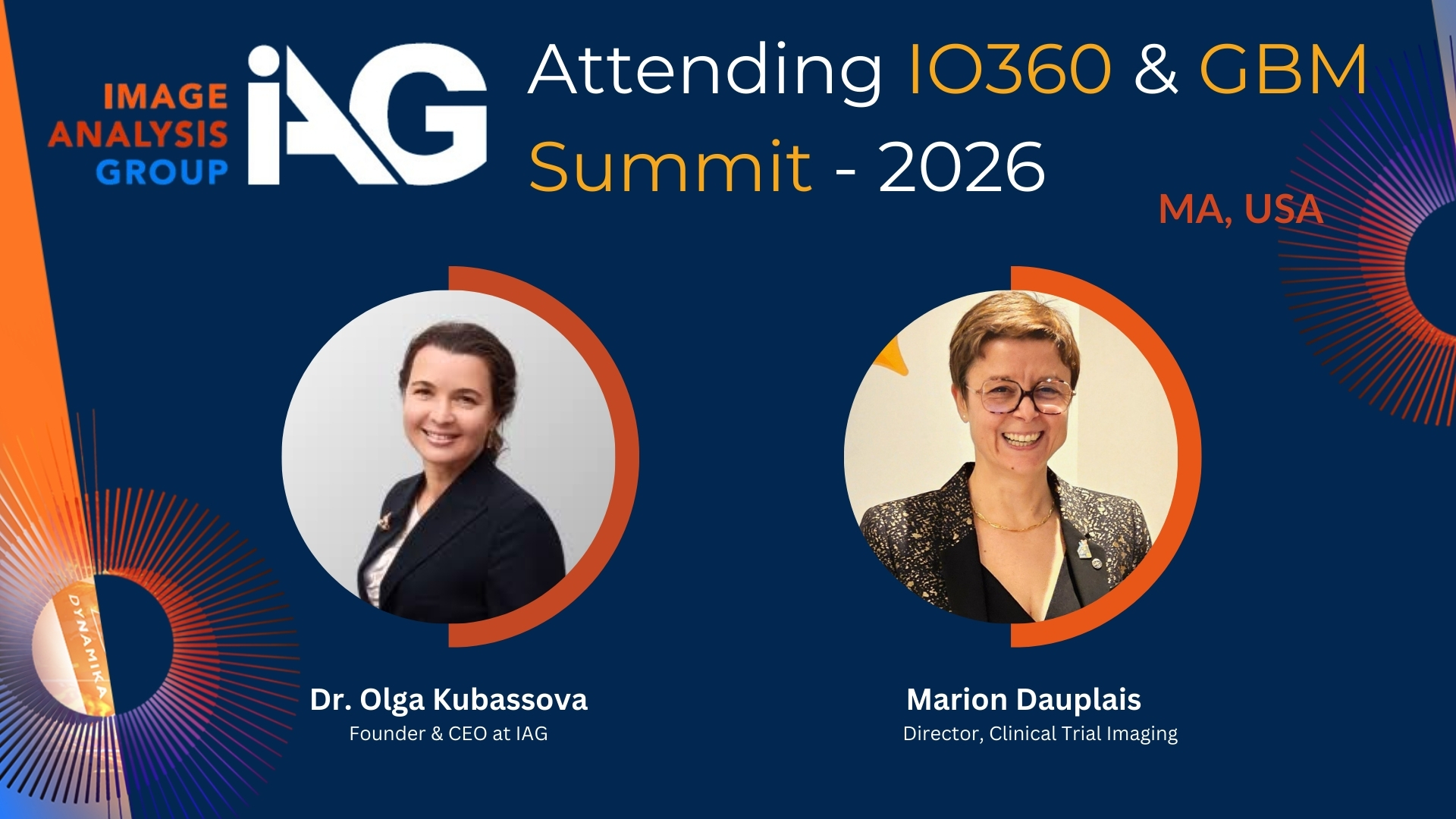
Meet IAG at IO360 and 7th GBM Summit 2026
Meet our team in Boston to explore how DYNAMIKA™ platform can help you advance imaging strategies, ensure smarter study design, de-risked decision-making, and deliver therapies to patients faster.
📅 Immuno-Oncology Summit 2026: February 10–12, 2026 |📍Boston, MA, USA
📅 7th Glioblastoma Drug Development Summit 2026: February 17–19, 2026 | 📍MA, USA
Advancing Oncology Trials
Image Analysis Group (IAG) is proud to announce our participation in two major oncology events this season – the Immuno-Oncology 360° Summit and the GBM Summit in Boston. We will join R&D leaders, clinical experts, and investors to discuss how centralized imaging, AI-driven endpoints, and radiomics can accelerate development in immuno-oncology and neuro-oncology trials.
Why Meet IAG?
- Reduce operational risk and variability with centralized imaging workflows and independent central review.
- Ensure high-quality, regulatory-ready imaging data across Phase I–IV oncology and neuro-oncology trials.
- Use DYNAMIKA™ as a central imaging data management and analytics platform to streamline site burden and monitoring.
- Leverage AI, radiomics, and quantitative endpoints without compromising scientific rigor or compliance.
Whether you are running early proof-of-concept IO studies or complex GBM trials, IAG’s scientific and operational teams work as an extension of your own, simplifying complex imaging processes and enabling reliable assessment of tumor response and progression.
Focus: Immuno-Oncology Imaging
At IO360 (February 10–12, Boston, MA) IAG will focus on imaging strategies that address the unique challenges of immuno-oncology trials.
- Immune-related response assessment and atypical response patterns.
- Integration of AI and radiomics to enhance sensitivity to treatment effects.
- Imaging biomarkers to support adaptive designs and early efficacy readouts in IO combinations and novel modalities.
You can discuss how to optimize imaging endpoints for PD-1/PD-L1, cell therapies, and other IO mechanisms, and how to operationalize these endpoints across global multi-site programs.
Focus: Neuro-Oncology and GBM Imaging
At the GBM Summit (February 17–19, Boston, MA), IAG will highlight solutions for glioblastoma and CNS tumor trials:
- Advanced MRI strategies to differentiate true progression from pseudoprogression.
- Centralized neuroradiology review and standardized protocols for GBM imaging.
- AI, radiomics, and longitudinal analytics to characterize tumor dynamics and treatment response.
We will explore how optimized imaging strategies can strengthen GBM endpoints, de-risk interpretation, and support more confident go/no-go and portfolio decisions.
Who Should Meet IAG in Boston?
- Biotech and pharma teams planning or running imaging-heavy oncology and neuro-oncology trials.
- Chief Medical Officers, Medical Directors, and Clinical Scientists defining imaging endpoints and evidence strategies.
- Clinical Operations & Program Leaders responsible for imaging logistics, timelines, and vendor oversight.
- CRO partners seeking a specialist imaging CRO to support complex global studies.
How To Contact?
To schedule time with the IAG team at IO360 (February 10–12) or the GBM Summit (February 17–19) in Boston:
- Email contact@ia-grp.com with your preferred conference (IO360 or GBM), date, and time.
- Briefly describe your current or upcoming trials so we can match you with the right scientific and operational experts.
We will coordinate a meeting around key sessions so you can discuss your immuno-oncology and GBM programs in person while you are in Boston.
Summit 2026 | FAQ
How do I request a meeting with IAG and what information should I prepare?
How do I request a meeting with IAG and what information should I prepare?
You can use the form above or contact@ia-grp.com indicating whether you’ll be attending, suggest preferred dates and times, and briefly outline your current or upcoming trials (indication, phase, key imaging needs) so IAG can match you with the right scientific and operational experts for a focused discussion.
Who from my organization should meet with IAG?
Who from my organization should meet with IAG?
Chief Medical Officers, Medical Directors, Clinical Scientists, Clinical Operations and Program Leaders, as well as BD and outsourcing teams, will all benefit from meeting IAG to refine imaging strategy, endpoints, logistics, and vendor oversight for current or planned trials.
What is DYNAMIKA™ and how would my team use it?
What is DYNAMIKA™ and how would my team use it?
DYNAMIKA™ is IAG’s proprietary imaging data management and analytics platform that serves as a single environment for image upload, quality control, quantitative analysis, and reporting, enabling near real-time visibility on trial progress and reducing site and monitoring burden.
How can IAG help with complex IO response patterns such as pseudoprogression or delayed responses?
How can IAG help with complex IO response patterns such as pseudoprogression or delayed responses?
IAG’s scientific team designs and implements immune-related response assessment strategies, incorporates appropriate imaging biomarkers, and uses AI and radiomics to better characterize atypical response patterns, supporting more accurate interpretation of treatment effect in IO trials.
What specific value does IAG bring to GBM and neuro-oncology studies?
What specific value does IAG bring to GBM and neuro-oncology studies?
For GBM and CNS tumor trials, IAG provides advanced MRI strategies to differentiate true progression from pseudoprogression, centralized neuroradiology review, standardized GBM imaging protocols, and longitudinal analytics to track tumor dynamics and support robust efficacy endpoints.
What types of trials does IAG typically support in immuno-oncology and GBM?
What types of trials does IAG typically support in immuno-oncology and GBM?
IAG supports imaging-heavy Phase I–IV oncology and neuro-oncology trials, including early proof-of-concept IO studies, PD-1/PD-L1 and cell therapy programs, and complex GBM and CNS tumor trials where radiological endpoints are critical for decision-making.
How does IAG’s centralized imaging model reduce risk in my trial?
How does IAG’s centralized imaging model reduce risk in my trial?
Centralized imaging with independent central review reduces site-to-site variability, standardizes acquisition and review protocols, and minimizes operational risk, helping sponsors generate consistent, regulatory-ready imaging datasets and avoid costly re-scans, delays, or data queries.
How does IAG use AI, radiomics, and quantitative endpoints in practice?
How does IAG use AI, radiomics, and quantitative endpoints in practice?
IAG deploys AI algorithms and radiomic feature extraction within validated workflows to derive quantitative imaging endpoints that increase sensitivity to treatment effects, while maintaining scientific rigor, auditability, and compliance with regulatory expectations.
Book a Meeting
Book time with our imaging experts to discuss how we can design, centralize, and read the imaging for your next trial, ensuring robust safety and efficacy assessment of your new drug candidate.
About Image Analysis Group (IAG)
Image Analysis Group (IAG) is a trusted partner to life sciences companies, combining deep expertise in medical imaging with the innovative power of its proprietary platform, DYNAMIKA™, to de-risk clinical development and accelerate the delivery of lifesaving therapies to patients. The IAG team designs and executes the imaging part of clinical trials that rely on radiological endpoints to demonstrate the safety and efficacy of new drug candidates. By using AI-powered endpoints and automating data management processes, with IAG you accelerate start-up and database lock, gain real-time visibility on trial progress, ensure clean data for regulatory submissions, and maximize patient recruitment speed.
For nearly 20 years, IAG has supported more than 700 clinical trials globally, helping biotech and pharmaceutical sponsors make confident, data‑driven decisions on their development portfolios.