How MRI-Driven DAVIX Became Part of DYNAMIKA™: From Research Collaboration to Clinical Trial Innovation
How MRI-Driven DAVIX Became Part of DYNAMIKA™: From Research Collaboration to Clinical Trial Innovation
How DAVIX Turned MRI Research Into a Clinical Trial Tool.
Advances in imaging often begin in the research lab, but their true impact is realized when they become practical tools for clinical trials. The development of the Digital Artery Volume Index (DAVIX) is one such story. What began as an academic collaboration to better understand vascular disease in systemic sclerosis has evolved into a scalable imaging biomarker now integrated within DYNAMIKA™ to support scalable analysis in clinical trials.
This journey, spanning collaboration with leading researchers, validation through peer-reviewed science, and translation into clinical trial infrastructure, demonstrates how imaging innovation moves from discovery to real-world impact. At the center of this story is a partnership between academic investigators and IAG working together to transform MRI into a quantitative clinical trial tool.
The Clinical Challenge: Measuring Vascular Disease in Systemic Sclerosis
Systemic sclerosis is characterized by progressive vascular damage, fibrosis, and immune dysregulation. One of its most debilitating complications is the development of digital ulcers, painful lesions that occur due to reduced blood flow in the small arteries of the fingers.
For researchers and drug developers, measuring vascular disease progression has been particularly difficult. Traditional clinical endpoints, such as ulcer count or patient symptoms, capture only part of the disease process. They are often variable, subjective, and slow to change.
MRI offers a promising alternative. Unlike traditional imaging modalities, MRI can visualize soft tissues, vascular structures, and inflammatory processes simultaneously. However, translating MRI data into reliable quantitative endpoints requires sophisticated image analysis and standardized methodologies.
This is where collaboration between imaging scientists, clinicians, and technology partners becomes critical.
The Birth of DAVIX: A Collaboration with the University of Leeds
To address this gap, researchers from the University of Leeds and international collaborators developed the Digital Artery Volume Index (DAVIX), an MRI-derived biomarker designed to quantify vascular health in the fingers.
The work, published in The Lancet Rheumatology, explored whether MRI could measure structural vascular changes associated with digital ulcer disease in systemic sclerosis.
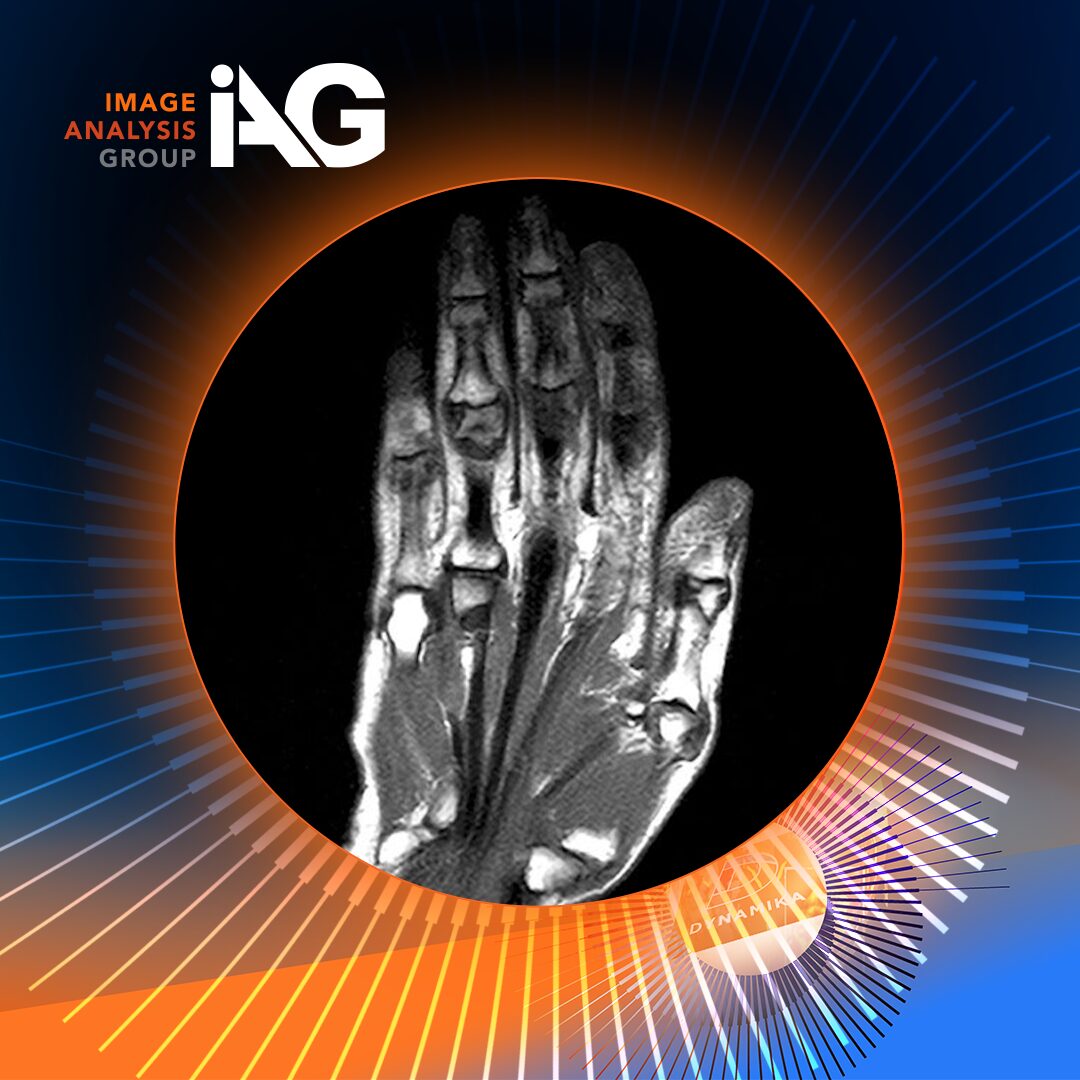
The DAVIX methodology calculates the ratio between digital artery volume and finger volume using high-resolution MRI scans. By quantifying arterial volume across multiple fingers, the metric provides a reproducible measurement of vascular status.
In the study, researchers demonstrated that DAVIX could:
- Quantify structural vascular changes in systemic sclerosis
- Predict the development of digital ulcers
- Provide a non-invasive biomarker for disease progression
The prospective cohort study enrolled patients from the Leeds scleroderma clinic and evaluated whether MRI-derived vascular measurements could predict clinical outcomes over time. Results showed that DAVIX has strong potential as a surrogate outcome measure, enabling earlier detection of vascular deterioration.
For clinical research, this is significant. A reliable imaging biomarker could help enrich patient populations, stratify risk, and potentially shorten clinical trial timelines.
Translating Research into Clinical Trial Methodology
Developing a promising biomarker is only the first step. For pharmaceutical trials, the real challenge lies in standardizing imaging workflows across multiple sites and ensuring that quantitative measurements remain reproducible.
This is where IAG’s expertise in imaging analysis and clinical trial infrastructure became essential.
Working alongside the Leeds research team, IAG helped operationalize the methodology, transforming a research concept into a deployable imaging workflow.
This involved:
- Designing standardized MRI acquisition protocols
- Developing automated image analysis pipelines
- Ensuring cross-site reproducibility for clinical trials
- Validating quantitative measurements across datasets
By translating academic methodology into a structured imaging workflow, IAG enabled DAVIX to move beyond the research setting and into multicenter clinical trials.
As Francesco Del Galdo, Professor of Rheumatology at the University of Leeds and a key investigator in the research, notes:
“MRI allows us to visualize the vascular changes underlying digital ulcer disease in systemic sclerosis. Quantitative approaches such as DAVIX provide an opportunity to measure these changes objectively and potentially improve how we evaluate therapies.”
From Imaging Biomarker to Clinical Trial Tool
Once validated, the next step was integrating DAVIX into scalable imaging technology that could support pharmaceutical trials.
Today, DAVIX operates within DYNAMIKA™, IAG’s advanced imaging platform designed to extract quantitative biomarkers from MRI data. By embedding the methodology directly into the platform, researchers can now analyze vascular imaging data using automated workflows.
Within DYNAMIKA™, the DAVIX workflow can:
- Process high-resolution MRI scans
- Identify and segment digital arteries
- Calculate vascular volume metrics
- Generate standardized quantitative outputs
This integration ensures that imaging data collected across clinical trial sites can be analyzed consistently, turning raw MRI scans into structured, regulatory-ready datasets.
For sponsors developing therapies targeting vascular disease in systemic sclerosis, this creates a powerful opportunity: objective, quantitative imaging endpoints that complement traditional clinical outcomes.
The Role of Imaging Partners in Modern Clinical Trials
The evolution of DAVIX illustrates a broader trend in drug development: the growing role of specialized imaging partners.
As imaging biomarkers become more complex, pharmaceutical companies increasingly rely on partners who can bridge the gap between academic discovery and clinical trial implementation.
In this context, IAG acts as more than a service provider. The company works alongside investigators, academic institutions, and industry sponsors to translate imaging innovation into trial-ready solutions.
This collaborative model ensures that promising research methodologies, like DAVIX, can be scaled across global trials while maintaining scientific rigor.
From protocol design to image analysis and regulatory-grade data outputs, imaging partners play a critical role in enabling next-generation biomarkers.
Why MRI Matters for the Future of Rheumatology Trials
MRI continues to gain traction as a powerful tool for studying inflammatory and vascular diseases. Unlike conventional imaging modalities, MRI can capture both structural and biological changes, making it particularly valuable for complex conditions such as systemic sclerosis.
Recent research highlights how MRI can visualize inflammation, vascular changes, and tissue remodeling in rheumatologic disease processes.
When combined with advanced analytics platforms like DYNAMIKA™, MRI becomes more than a diagnostic modality, it becomes a quantitative research tool.
For clinical trials, this opens the door to:
- Earlier detection of treatment response
- Objective measurement of disease activity
- Better patient stratification
- Reduced variability in endpoints
Ultimately, these capabilities could help accelerate the development of new therapies for patients with complex autoimmune diseases.
From Collaboration to Clinical Impact
The journey of DAVIX, from an academic collaboration at the University of Leeds to a clinical trial tool embedded within DYNAMIKA™, demonstrates what is possible when imaging science and technology development move forward together.
It is a story of multidisciplinary collaboration: clinicians identifying an unmet need, researchers developing a novel biomarker, and imaging specialists transforming that discovery into a scalable clinical trial solution.
For sponsors exploring innovative endpoints in systemic sclerosis and vascular disease, such partnerships provide the foundation for more precise, data-driven clinical research.
See DAVIX in Action
To learn more about how DAVIX works within the DYNAMIKA™ platform, and how MRI biomarkers can support clinical trials in rheumatology, you can now access the recording of our webinar held on March 19, 2026.
In this session, experts from Image Analysis Group and collaborating institutions demonstrated how advanced imaging analytics are helping researchers move from qualitative interpretation to quantitative trial endpoints.
Request access to the webinar recording to see how MRI-driven biomarkers are shaping the future of clinical research: contact@ia-grp.com.